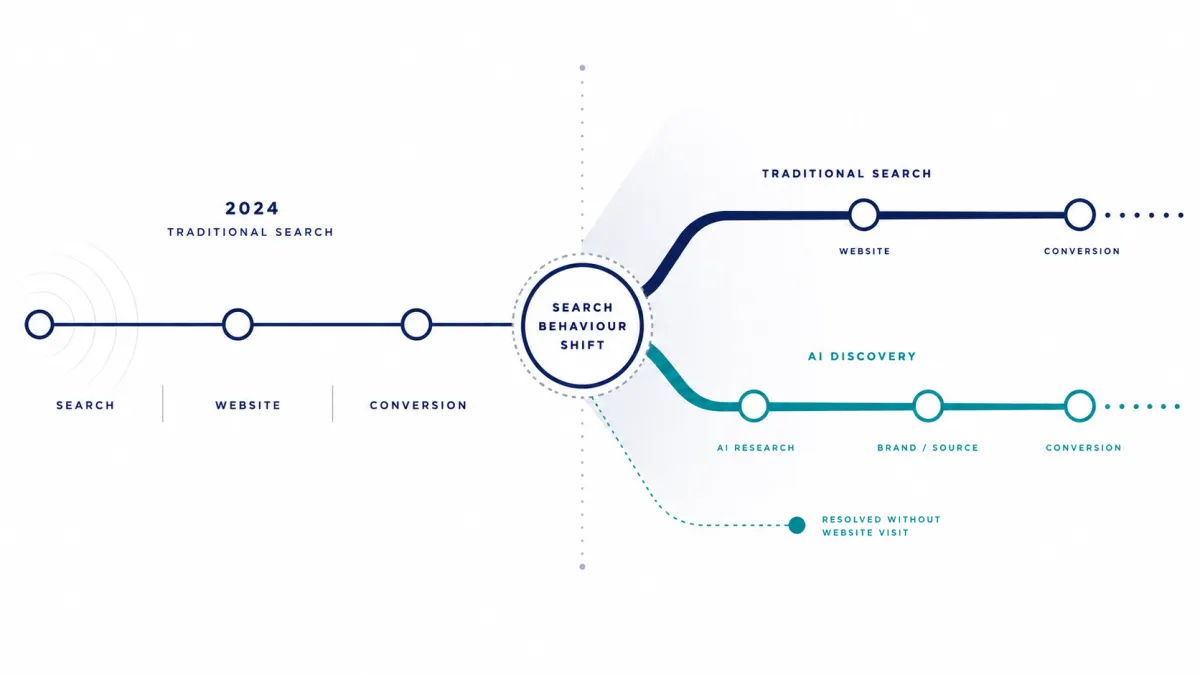
Search Behaviour Has Shifted Twice Since 2024 - DMByJS
Search Behaviour Has Shifted Twice Since 2024 - Has Your Marketing Plan?
If your website traffic has declined over the past year despite stable or improving search rankings, the problem may not be a Google penalty. Something more fundamental has changed-twice.
These shifts are changing how customers discover, research, and compare businesses online. The result? A business can maintain strong search visibility while receiving fewer website visits or enquiries, making traditional marketing reports harder to interpret.
This article explains the two major shifts reshaping online discovery, what they mean for your marketing strategy, and how businesses can adapt.
Why This Matters
Every marketing plan is built on a simple assumption: rank well, attract clicks, and turn those visitors into leads.
That assumption is now only partly true.
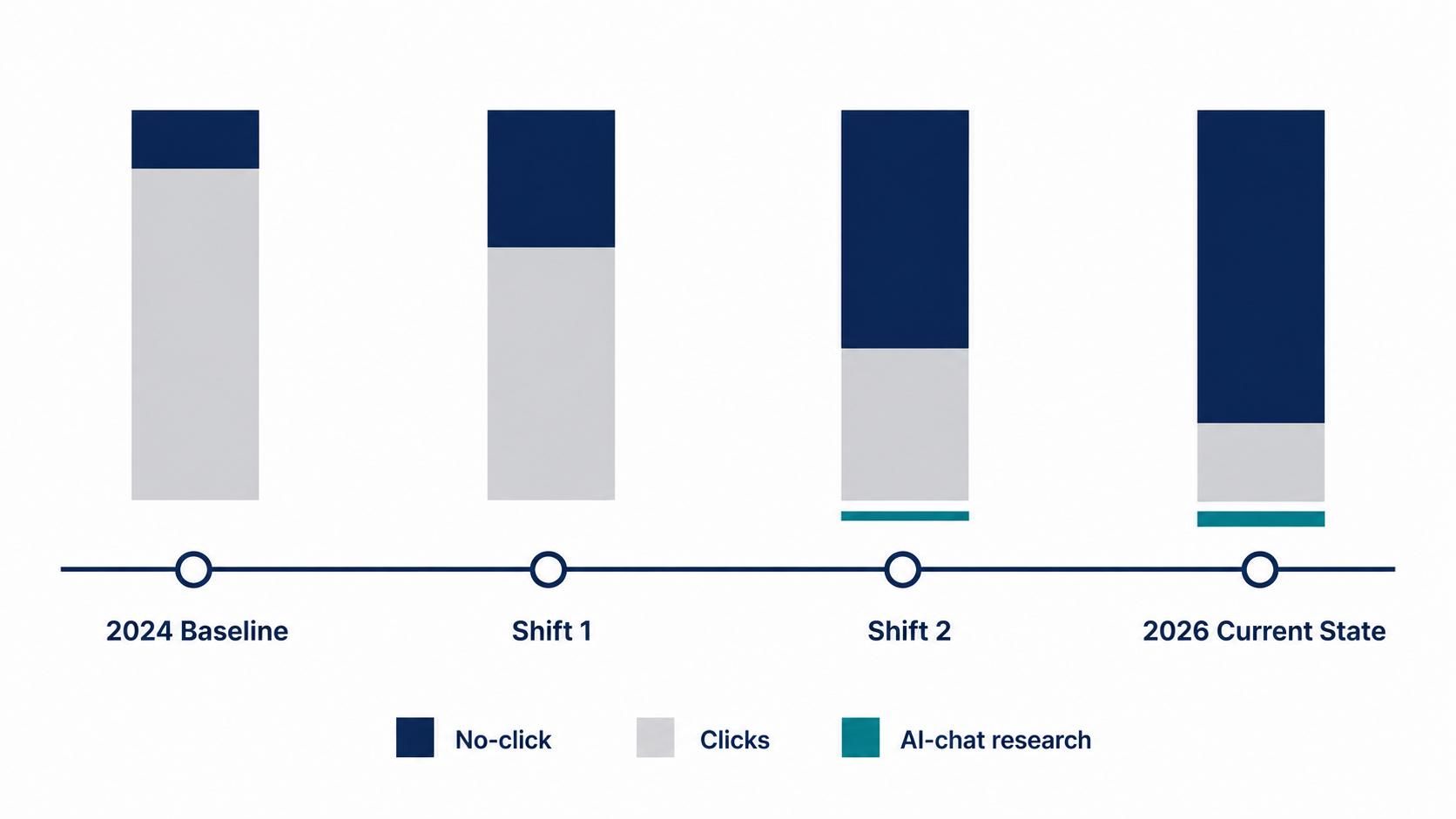
Statistic Callout: Spark Toro's 2026 analysis of Similarweb clickstream data found that the share of Google searches resulting in at least one click fell by roughly 9.5 percentage points between 2024 and 2026-a decline of nearly 23% in two years.
In other words, even when your content ranks well, some potential customers may get the information they need without visiting your website.
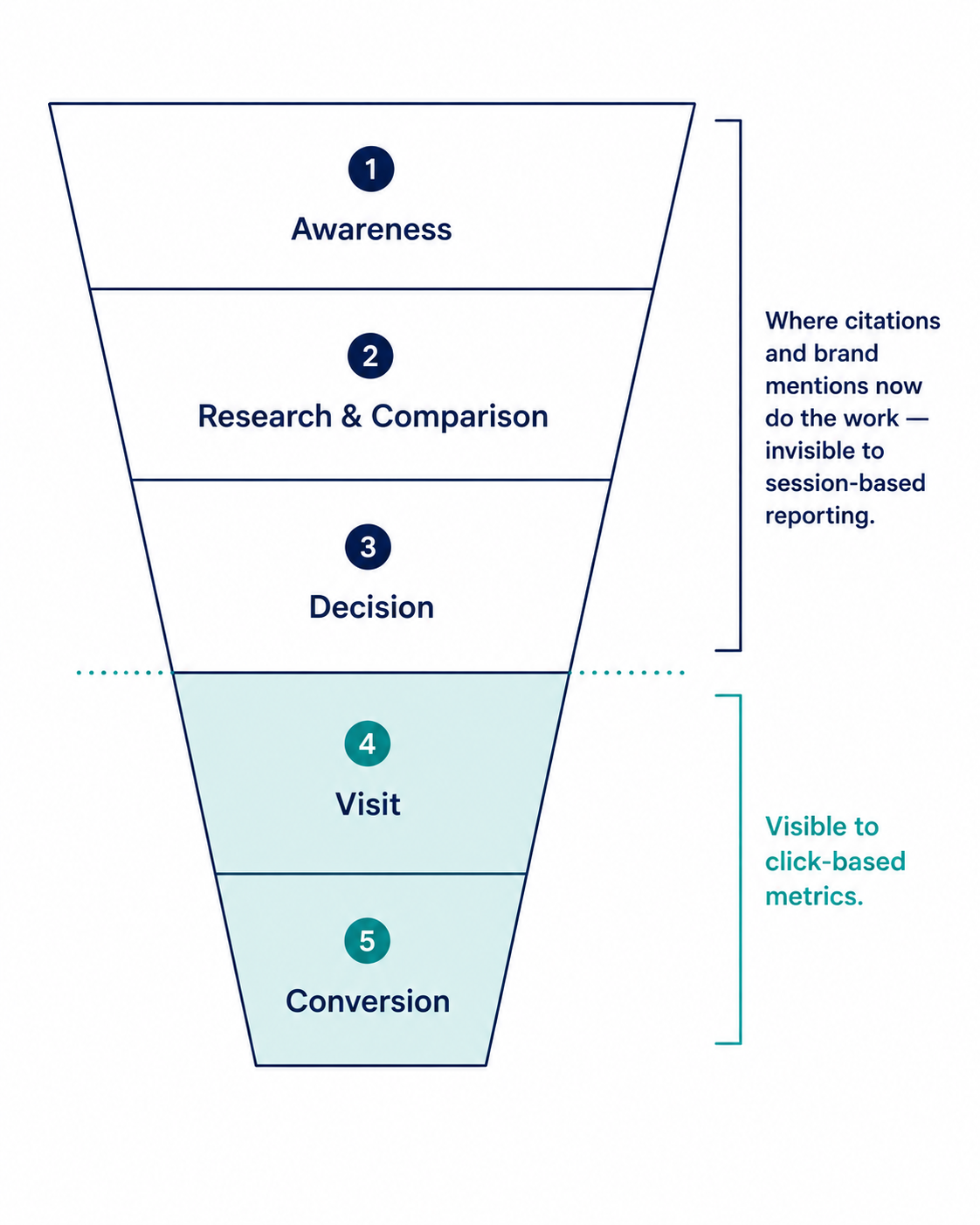
The bigger challenge is measurement. Rankings, visibility, clicks, and website sessions no longer tell the whole story of how customers discover and evaluate a business.
The First Shift: Google Sends Fewer Clicks
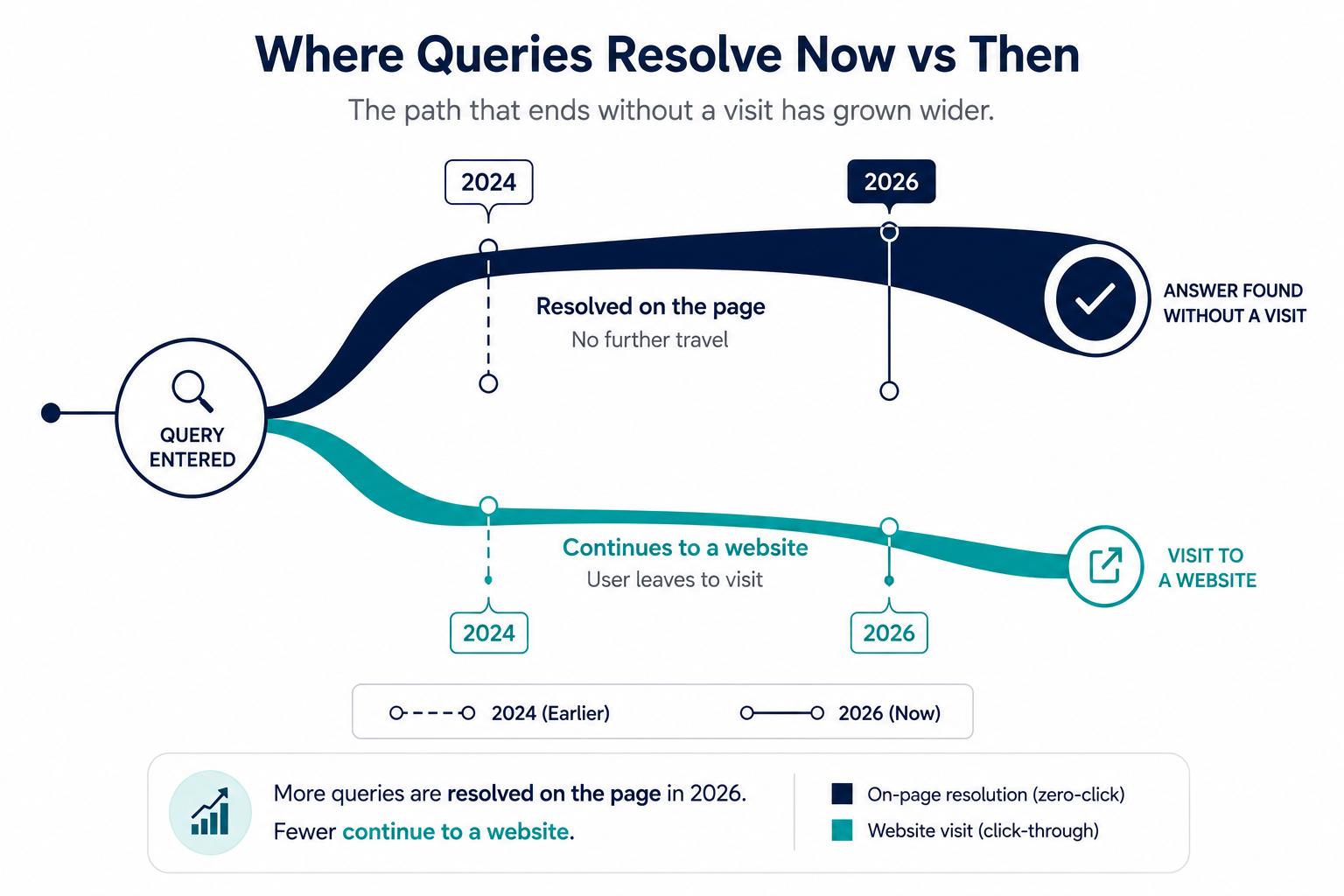
Definition: Zero-click search happens when someone gets the information they need directly on the search results page-from an AI Overview, featured snippet, knowledge panel, or similar result-without visiting a website.
Zero-click searches aren't new. Google has answered simple queries such as weather, calculations, and quick facts directly in search results for years. What changed after 2024 is the scale and complexity of the queries being answered. AI Overviews have expanded into comparisons, how-to questions, and early-stage research that previously led users to websites.
The impact is even more noticeable when an AI Overview appears. Multiple 2026 analyses from SparkToro, Similarweb, and Bain & Company indicate that zero-click behavior increases significantly when an AI Overview is present.
The practical takeaway: ranking #1 is no longer the finish line. Your brand can be visible without receiving the click. SEO now needs to focus not only on rankings, but also on creating content that search engines can understand, trust, and surface.
The Second Shift: People Started Asking Instead of Searching
Definition: Conversational search happens when people use AI tools to ask questions, compare options, and refine their decisions through follow-up questions instead of making a series of traditional searches.
The difference is more than a new interface. AI tools can compress several research steps into one conversation. Instead of searching for the best digital marketing agency, opening multiple websites, comparing services, and then looking for reviews, a business can ask an AI tool to compare agencies, evaluate their expertise, and recommend options based on its specific goals.
This changes where businesses need to be visible. Potential clients may form a shortlist before they ever visit a company's website, based on the information, reviews, recommendations, and sources an AI system presents.
The practical takeaway: being discoverable increasingly means being represented in the conversation-not simply appearing in a list of search results.
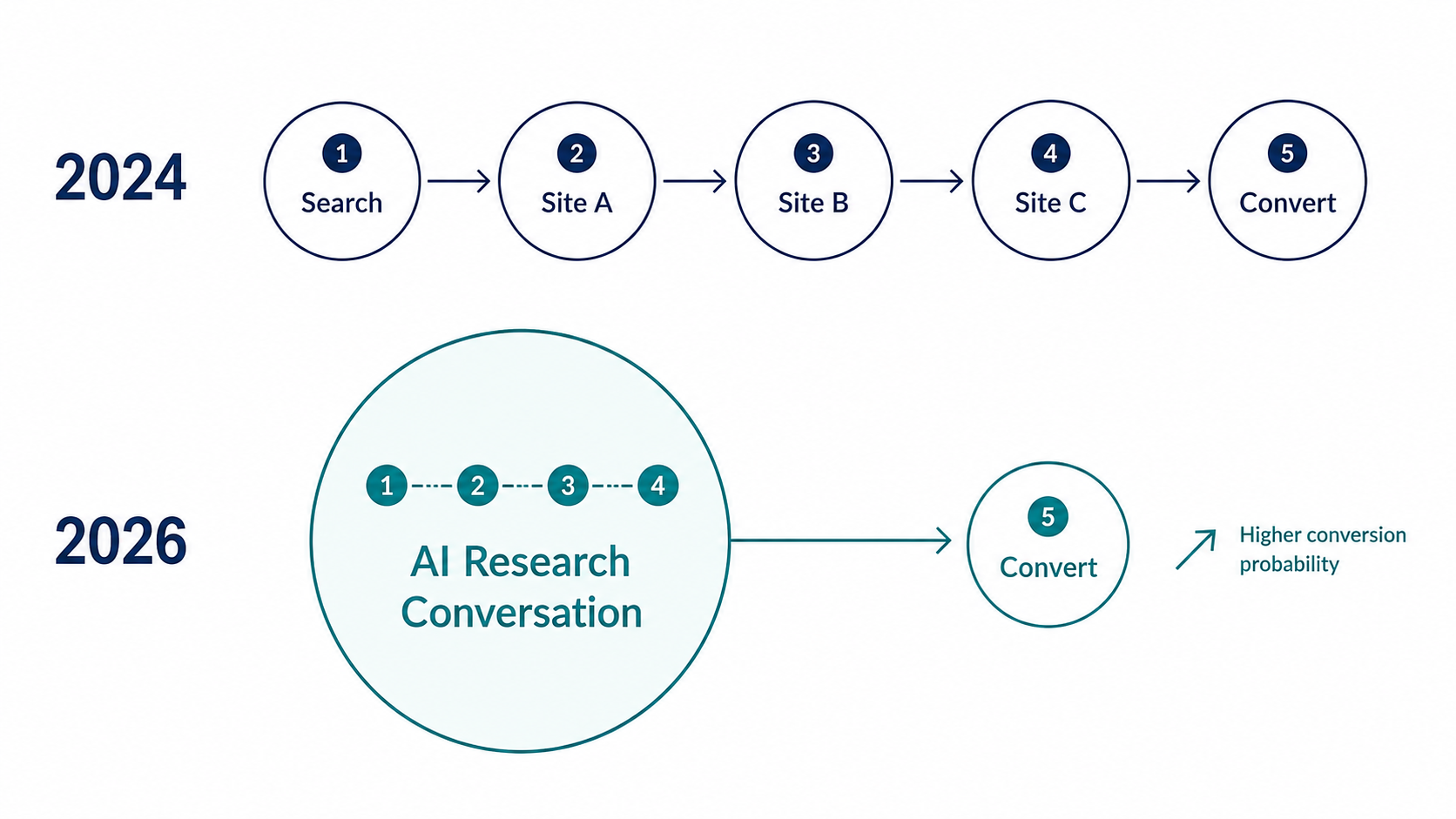
Statistic Callout: AI tools are becoming part of the research journey, with users increasingly asking conversational platforms to compare options, answer follow-up questions, and build shortlists before visiting a business website.
This changes what it means to be discoverable. Your brand doesn't just need to rank in search-it needs to be visible in the sources and recommendations that shape the customer's decision.
For a business looking for marketing support, that could mean appearing when someone asks an AI tool which digital marketing agency is best for a specific industry, which SEO strategy would suit their business goals, or which agencies are worth considering.
Why This Isn't Just an "SEO Problem"
It's tempting to view these shifts as another SEO issue. But their impact extends beyond search rankings.
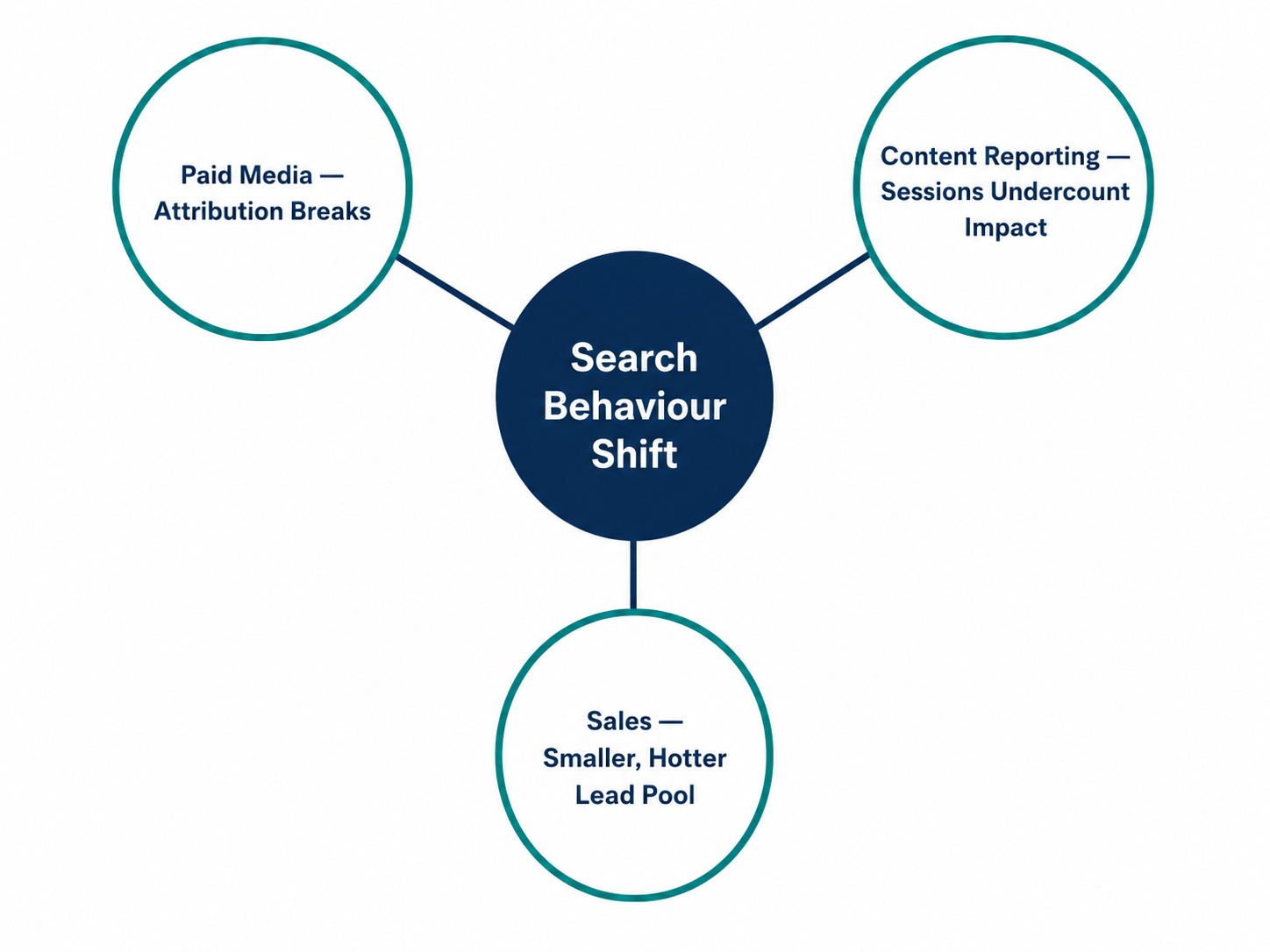
Paid media assumptions are changing. If customers increasingly research through AI tools before clicking an ad, businesses may need to rethink how they approach attribution, audience signals, and bidding strategies.
Content ROI is harder to measure. Content can influence a buying decision through an AI-generated answer without generating a website visit, making clicks and sessions an incomplete measure of its impact.
Sales follow-up matters too. When fewer prospects reach your website, each qualified enquiry becomes more valuable. Faster follow-up and stronger nurturing can help businesses make the most of the leads they do receive.
These shifts affect how customers discover businesses, how marketing impact is measured, and how sales teams respond. That's why this is a business strategy issue-not just an SEO consideration.
What This Looks Like in Practice
A digital marketing agency. Its website may still rank well for important service and industry searches, but potential clients are increasingly using Google and AI tools to compare agencies, services, expertise, reviews, and recommendations before visiting a website. If an agency isn't present in the sources AI systems rely on when forming recommendations, it may be left out of the customer's shortlist. The solution isn't simply publishing more service pages-it is building credible visibility across the sources potential clients use to research and evaluate agencies.
A D2C brand. Paid search costs may rise while landing-page conversion rates remain healthy. The problem isn't necessarily the traffic that arrives; it can be the customers who complete more of their research through AI Overviews and conversational tools before they ever see an ad or visit the website.
The common thread: the issue isn't that traditional marketing practices have stopped working. The environment in which customers discover and evaluate businesses has changed.
Best Practices: What Businesses Should Actually Do About It
Track visibility, not just clicks. Monitor AI referrals, branded searches, brand mentions, and-where available-AI citations alongside rankings, sessions, and conversions. The goal is to understand where customers discover and consider your brand, not just where they click.
Lead with a direct answer. Structure important pages so the opening section answers the primary question clearly and in plain language. This makes content easier for both users and search systems to understand and extract.
Keep content easy to scan. Use short paragraphs, clear headings, bullet points, and direct answers. A simple structure helps readers find information quickly and makes key information easier for search and AI systems to interpret.
Build brand presence beyond your website. Contribute to industry publications, partner directories, podcasts, comparison sites, and trusted review platforms-not just for backlinks, but because customers increasingly discover brands through multiple sources.
Keep important content up to date. Refresh statistics, examples, product information, and factual claims when the topic or market changes. Update content to keep it accurate and useful, not simply to make it appear “fresh.”
Invest in first-party data and CRM. As top-of-funnel traffic becomes harder to measure, the leads that do arrive become more valuable. Faster follow-up, better segmentation, and stronger nurturing can help businesses make the most of each opportunity.
Common Mistakes: Where Businesses Get This Wrong
Judging content success only by sessions. Content can influence a customer's decision without generating a website visit. Sessions are still useful, but they no longer tell the whole story.
Cutting SEO investment because clicks are declining. Instead of reducing investment, reassess what SEO should deliver: visibility, qualified discovery, brand authority, and demand-not simply more sessions.
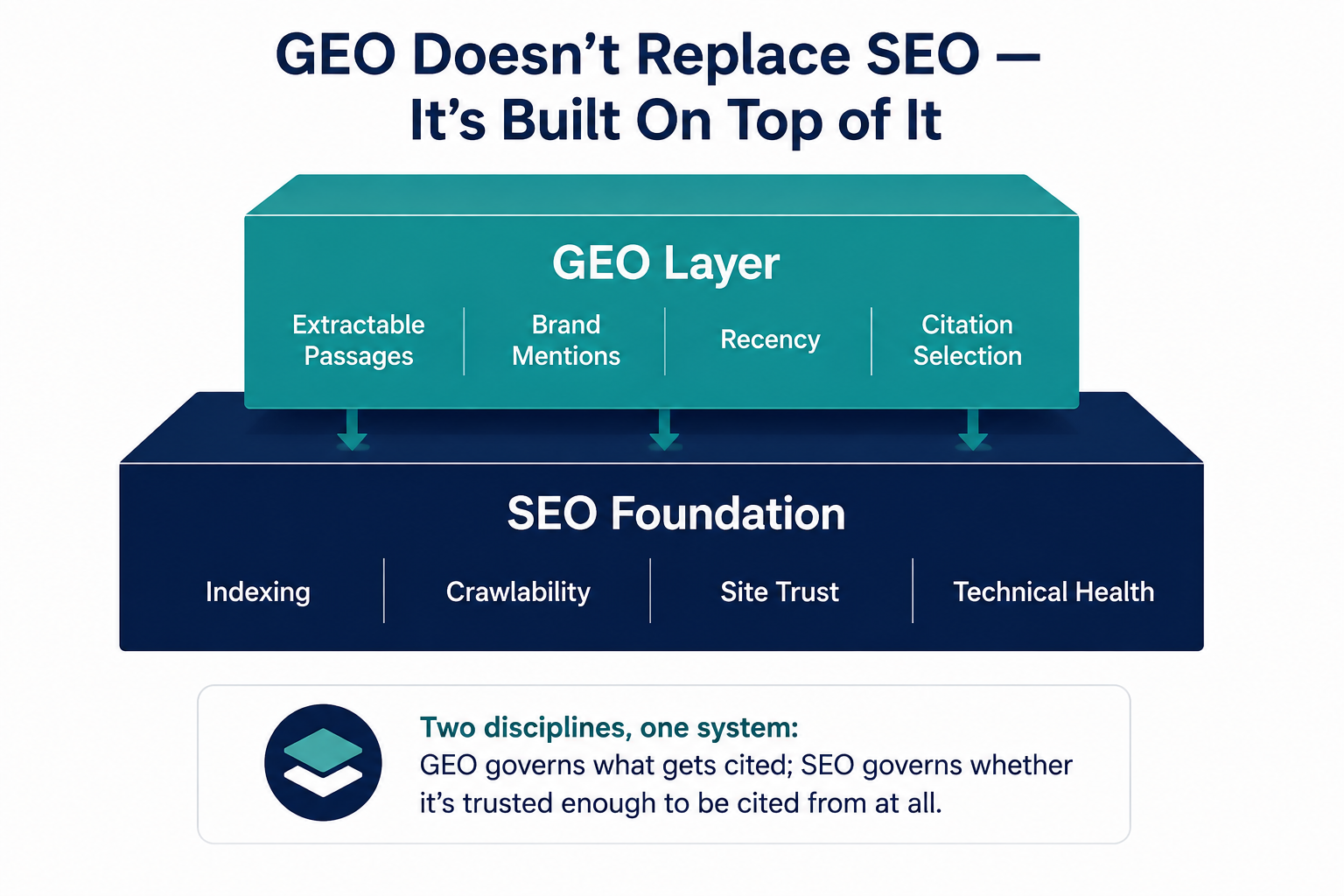
Optimising for AI visibility while ignoring SEO fundamentals. GEO builds on technical SEO, site authority, useful content, and trust. It doesn't replace them.
Ignoring the sales-side impact. When fewer prospects reach your website, every qualified enquiry becomes more valuable. Faster responses, stronger qualification, and consistent follow-up can help convert more of the opportunities you do receive.
Warning Callout
Don't confuse “traffic is down” with “marketing isn't working.” Before cutting a channel or reducing your budget, determine whether visibility, brand discovery, or actual business results have declined. These are no longer interchangeable measurements.
Search Behaviour: 2024 vs 2026
What to Measure Now vs What Not to Rely on Alone
Frequently Asked Questions
Q1. Is zero-click search bad for my business?
Not necessarily. Zero-click search changes how visibility translates into business impact, but visibility still matters. A brand can influence customers through AI-generated answers, featured results, and search summaries without receiving a website visit.
The bigger risk is measuring performance through traffic alone. Visibility, brand mentions, citations, and assisted conversions are increasingly important alongside website sessions.
Q2. Should I stop investing in SEO?
No. SEO is becoming more important not less, but its role is changing.
Technical SEO, crawlability, structured content, authority, and trust remain fundamental. Build on these foundations with content that directly answers customer questions and can be surfaced across traditional and AI-driven search.
SEO and AI visibility should be treated as connected parts of the same search strategy.
Q3. What's the difference between SEO, GEO, and AEO?
SEO improves visibility in traditional search results. AEO (Answer Engine Optimization) helps answer engines understand and surface direct answers. GEO (Generative Engine Optimization) focuses on visibility across generative AI platforms such as ChatGPT, Perplexity, Gemini, and AI-powered search.
The terminology is still evolving, but the goal is similar: make your expertise easier for search engines and AI systems to understand, trust, and reference.
Q4. How do I know if AI tools are citing my business?
Start with the questions your customers ask before making a purchase. Test those queries across ChatGPT, Perplexity, Gemini, and Google AI Overviews to see whether your business appears, which competitors are recommended, and which sources are referenced.
Track these results over time. AI visibility is not a one-time SEO check; it needs ongoing monitoring.
Q5. Does this affect small or local businesses too, or only large brands?
It affects businesses of every size. For local businesses, “near me” searches, reviews, service-area queries, and local recommendations make this shift particularly important.
Google Business Profile information, reviews, local SEO, website content, and brand reputation can all influence how customers discover a business.
The goal isn't to compete with every brand online, but to become one of the most credible answers for the searches that matter to your customers.
Q6. What's the first practical step?
Start with measurement, not another content campaign.
Review how customers currently discover your business across Google and AI platforms. Establish a baseline for branded search, organic visibility, AI referrals, brand mentions, and-where measurable-AI citations.
Once you understand where your business appears and where competitors are being recommended instead, you can identify which content, SEO, reputation, or distribution efforts need attention.
Key Takeaways
Search has moved beyond the traditional results page. Zero-click experiences and AI-powered discovery are changing how customers find, compare, and evaluate businesses before visiting a website.
A #1 ranking no longer guarantees a click. Search visibility and website traffic are increasingly separate outcomes, so rankings and organic sessions shouldn't be treated as standalone measures of success.
AI discovery can influence customers before they reach your website. Your presence across trusted sources, useful content, reviews, and industry conversations can shape consideration before a website visit.
SEO isn't disappearing-it is expanding. Technical SEO remains essential, but businesses also need clear, trustworthy content that AI systems can understand and reference, while measuring visibility and brand discovery alongside traffic and conversions.
Your Search Visibility Is Changing. Is Your Marketing Strategy Keeping Up?
Search behaviour is changing faster than traditional reporting can capture. Your business may still rank and generate traffic while losing visibility during AI-driven research before customers reach your website.
DMByJS can help you understand where your brand stands.
Request a Free Search Visibility Audit to see how your brand appears across traditional search and AI-generated answers, where competitors are gaining visibility, and where opportunities may be getting missed.
You'll receive a clear visibility assessment and prioritised recommendations across SEO, content, and AI discoverability-so you can focus your efforts where they matter most.
→ Request Your Free Search Visibility Audit