
What Google's AI Overviews Really Change About Search Visibility
What Google's AI Overviews Really Change About Search Visibility
Quick Answer
Google AI Overviews change search visibility in three concrete ways. First, they can occupy a significant portion of the visible screen before a traditional organic listing appears. Second, appearing in an AI Overview is not determined by ranking position alone: Google's systems select and cite sources based on factors such as relevance, extractable content, authority, and freshness. Third, a strong organic ranking does not guarantee citation, with recent studies showing that a meaningful share of AI Overview citations can come from outside the traditional top 10. The practical result is that a business can hold a strong ranking and still be absent from the AI-generated answer a searcher sees first.
Introduction
A client dashboard can show a page holding position two or three for months while organic sessions on that page quietly decline.
That's not necessarily a tracking error. It can happen when a page continues to rank well in traditional search results but isn't prominently surfaced within an AI-generated answer.
AI Overviews represent one of Google's biggest changes to how search results are presented in recent years, yet many businesses still evaluate search performance primarily through rank position and organic traffic. As search behaviour continues to evolve, our guide to how search behaviour has shifted since 2024 explores the broader changes businesses need to account for. This article breaks down what AI Overviews change, what is known about how Google selects sources to cite, and what that means for a business trying to stay visible.
Why This Matters
Before AI Overviews became common, a page ranking on page one generally had a stronger opportunity to earn a click, although position and search intent still influenced that likelihood.
That's no longer a safe assumption.
Statistic Callout: Some industry analyses have found that when AI-generated results and other prominent SERP features appear together, they can occupy a substantial share of the visible screen—potentially pushing traditional organic listings further below the fold, particularly on mobile.
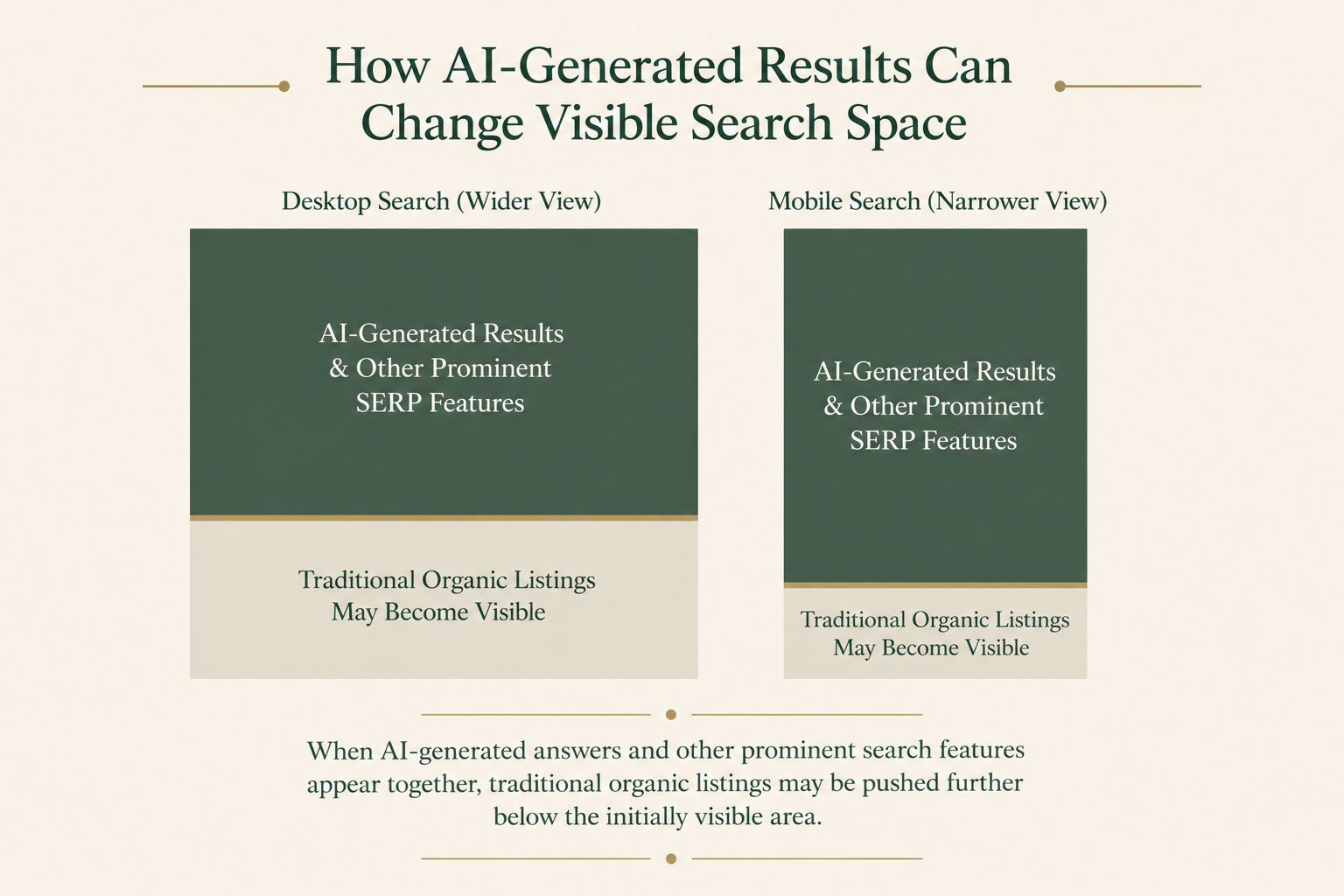
Separate industry studies have also reported declines in organic click-through rates for queries where AI Overviews appear. The exact impact varies by query type, dataset, industry, and study methodology, but the broader pattern is clear: a strong ranking no longer guarantees visibility or a click when an AI-generated answer dominates the search results page.
What an AI Overview Actually Is
Definition: An AI Overview is a Google-generated response that can appear prominently in search results, synthesising information from multiple sources into a direct answer and linking to supporting pages.
The feature evolved from Google's Search Generative Experience (SGE), which was introduced in May 2023. Google later launched AI Overviews in the US in May 2024 and expanded the feature to additional countries and markets throughout 2024.
AI Overviews are now an established part of Google's search experience, although they do not appear for every query and their availability can vary depending on the search, location, and other factors.
What this means practically: page-one rankings still matter, but for queries where an AI Overview appears prominently, ranking well alone may not guarantee that your content receives the same level of visibility or traffic it once did.
Ranking and Citation Are Now Two Different Games
This is an important mental shift for any business evaluating its search performance in 2026.
Ranking well in Google's traditional search results and being selected as a source within an AI Overview are related, but they are not the same outcome. A strong organic ranking can increase a page's visibility and may improve its chances of being considered, but Google does not publish a fixed formula explaining exactly how sources are selected for AI Overviews.
Research and industry testing suggest that factors such as relevance to the specific query, content quality, clarity, authority, and how easily information can be extracted may all influence which sources are surfaced. However, the exact selection process is not publicly known.
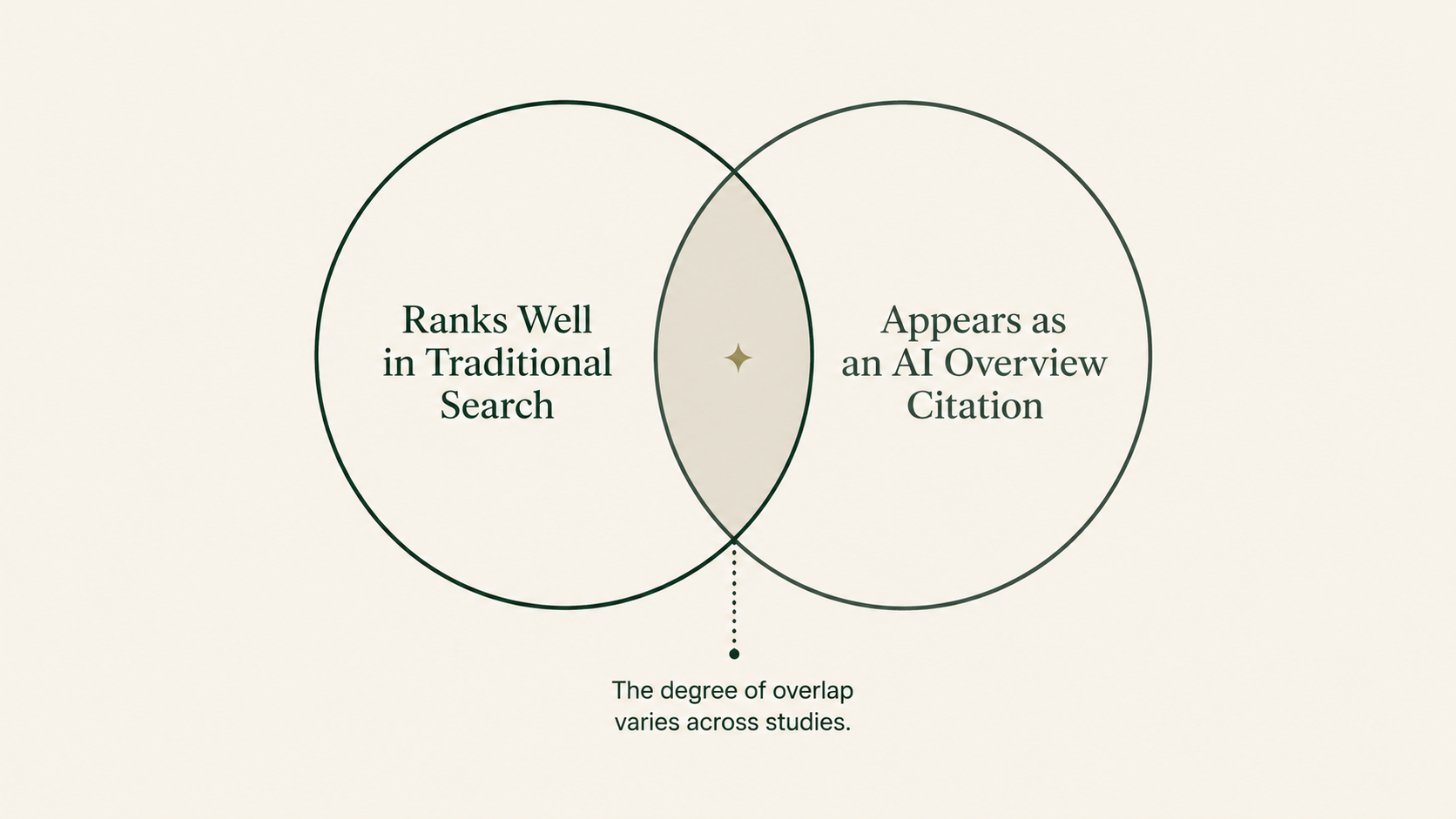
Statistic Callout: Recent industry studies have reached different conclusions about how closely AI Overview citations overlap with traditional organic rankings. Some analyses suggest that a meaningful share of cited pages rank outside the traditional top 10, while others have found a much stronger overlap. The exact percentage varies depending on the dataset, query set, market, and methodology-but the broader takeaway remains the same: a strong organic ranking can help, but it does not guarantee inclusion in an AI Overview.
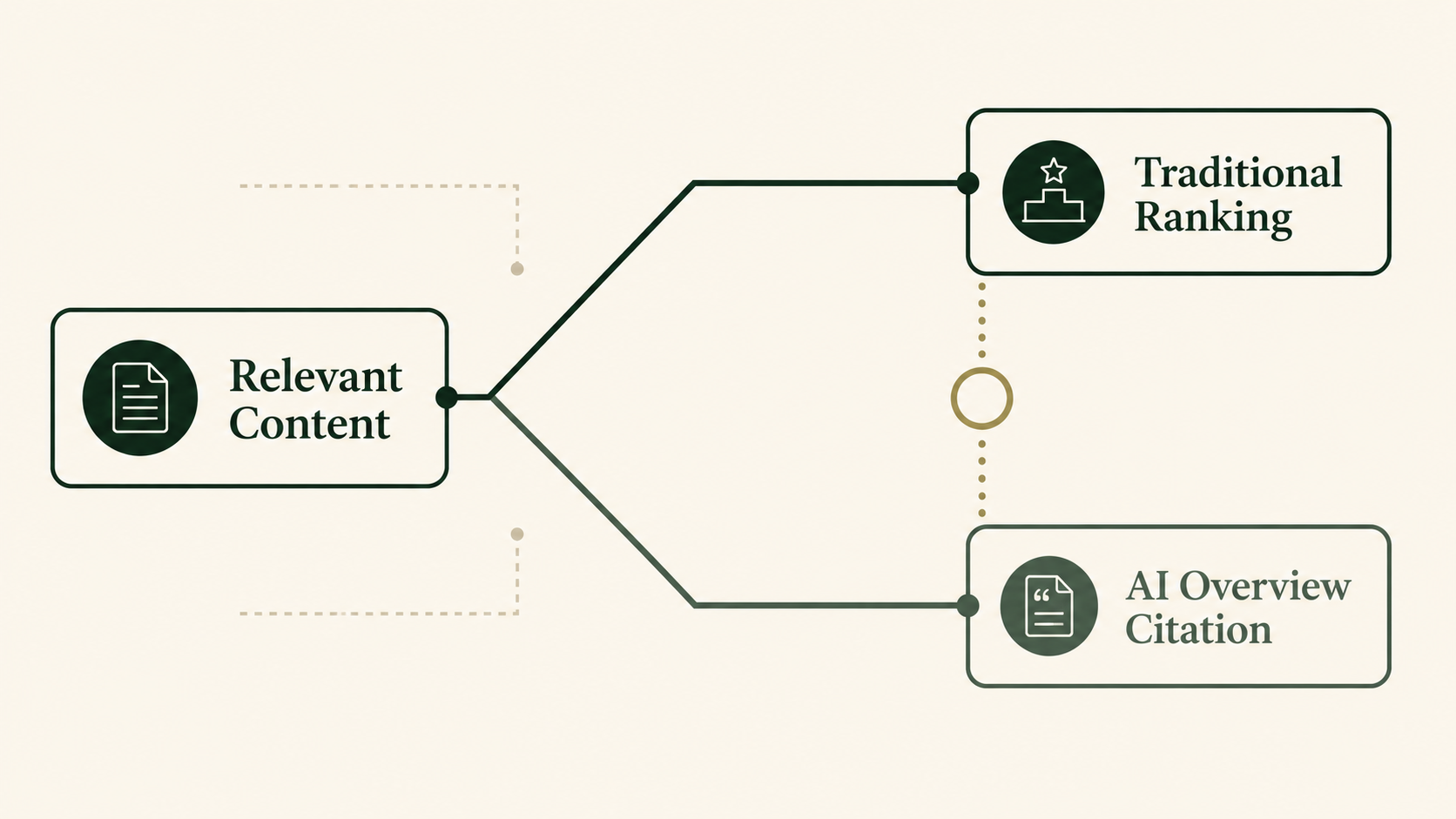
What this means practically: two businesses can rank similarly for the same query and still have different levels of visibility within AI-generated search results. Ranking remains important, but businesses should also focus on creating clear, useful, trustworthy content that directly answers the questions their audience is asking.
Why So Few Sites Ever Get Cited
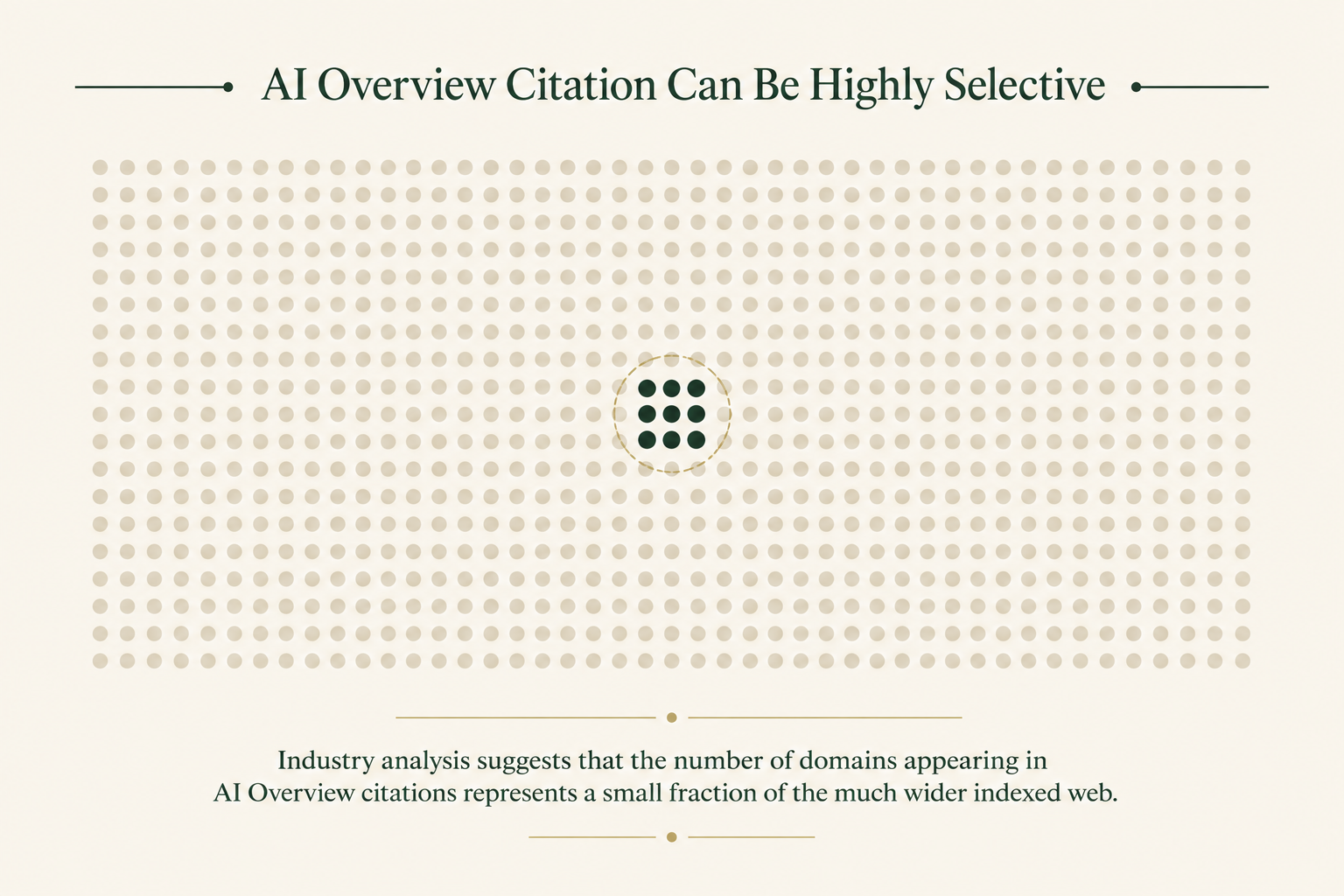
AI Overview citations can be highly selective. An AI-generated answer may draw from only a limited number of sources, meaning that many pages competing for visibility may never appear as a cited source-even when they are indexed and rank in traditional search results.
According to analysis from Averi.ai, only around 274,455 domains had appeared in an AI Overview citation compared with an estimated 18.4 million domains in Google's index. While figures like these depend on the dataset and methodology used, they illustrate how limited citation visibility can be compared with the size of the wider web.
Research into AI Overview citations also suggests that source patterns can vary by query type and topic. Community platforms, professional publishing platforms, news sites, specialist publications, and other third-party sources may appear alongside traditional websites depending on the information Google considers useful for a particular query.
What this means practically: a strong website remains important, but it may not be the only place where potential customers encounter information about your brand. Building credible visibility through relevant third-party sources, industry publications, reviews, professional platforms, and other trusted channels can strengthen your overall presence across the wider search and research journey.
What Actually Gets Chosen
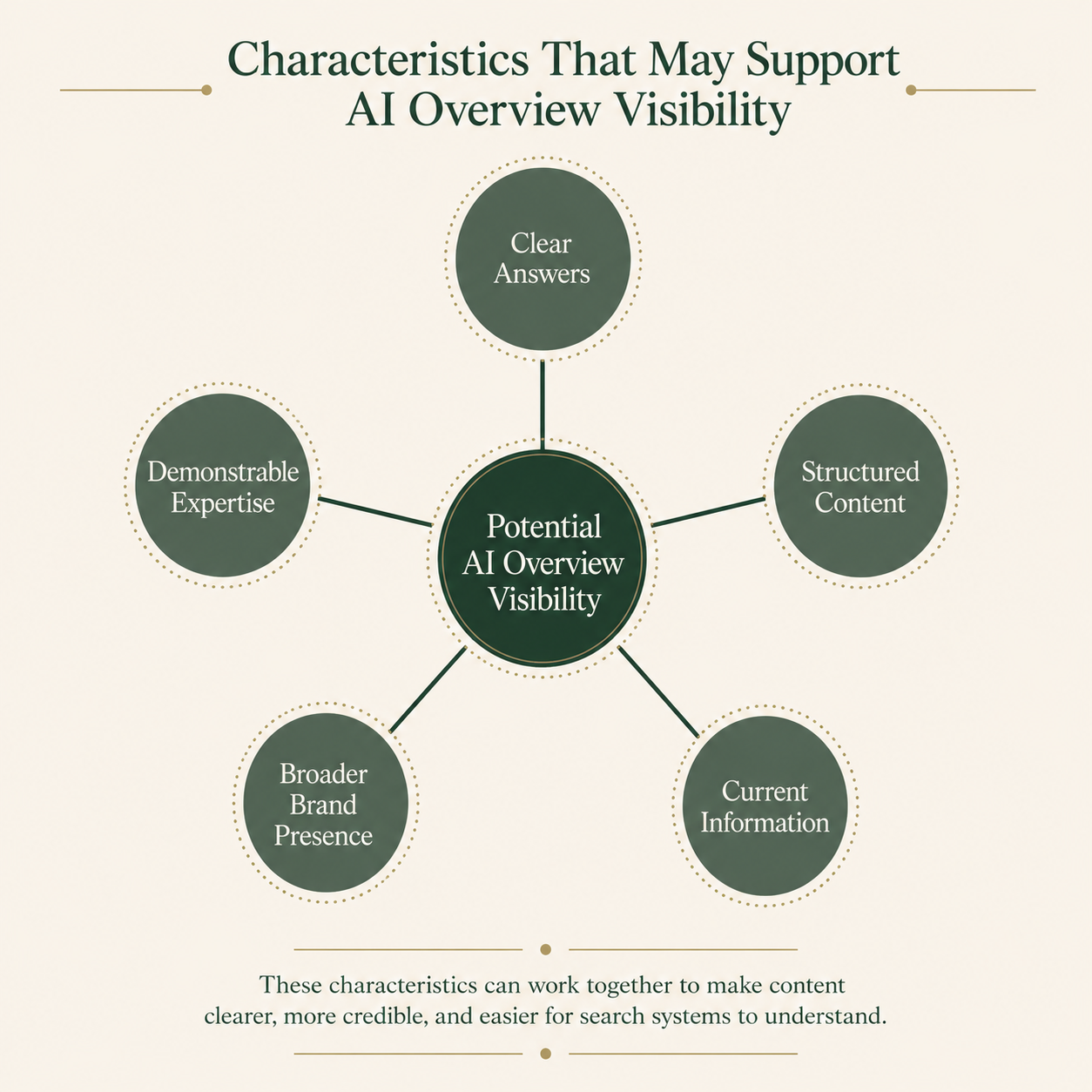
There is no publicly confirmed formula for how Google selects sources for AI Overviews. However, current research and Google's own guidance point to several characteristics that can make content easier to understand, evaluate, and potentially surface.
Clear, self-contained answers. Content that directly answers a specific question and provides enough context to stand on its own may be easier for search systems to extract and use than information buried inside long, unfocused paragraphs.
Demonstrable expertise and trust. Clear authorship, accurate information, relevant experience, and evidence of expertise can help strengthen the overall credibility of a source. These signals should support the content naturally rather than being added purely as optimisation tactics.
Structured, well-organised content. Clear headings, logical page structure, and relevant structured data can help search engines better understand the purpose and content of a page. Schema can support interpretation, although it does not guarantee inclusion in an AI Overview.
Broader brand presence. Mentions and discussion across credible third-party websites may contribute to a brand's wider visibility and authority. However, correlation between brand mentions and AI citations should not be treated as proof of a direct ranking or citation factor.
Current and accurate information. For topics where information changes frequently, regularly reviewing and updating content can help ensure that outdated information does not become a disadvantage. Freshness is likely to matter more for time-sensitive topics than for genuinely evergreen content.
Expert Insight Callout: Google's own guidance indicates that there are no special technical requirements for appearing in AI Overviews beyond being eligible for Google Search and following standard Search Essentials. The strongest approach is not to look for a separate "AI Overview formula," but to continue improving the fundamentals: helpful content, clear structure, technical accessibility, and credible information that is easy for both users and search systems to understand.
The Upside Nobody Talks About
Most of the conversation around AI Overviews focuses on the potential loss of organic clicks. But that is only one side of the picture.
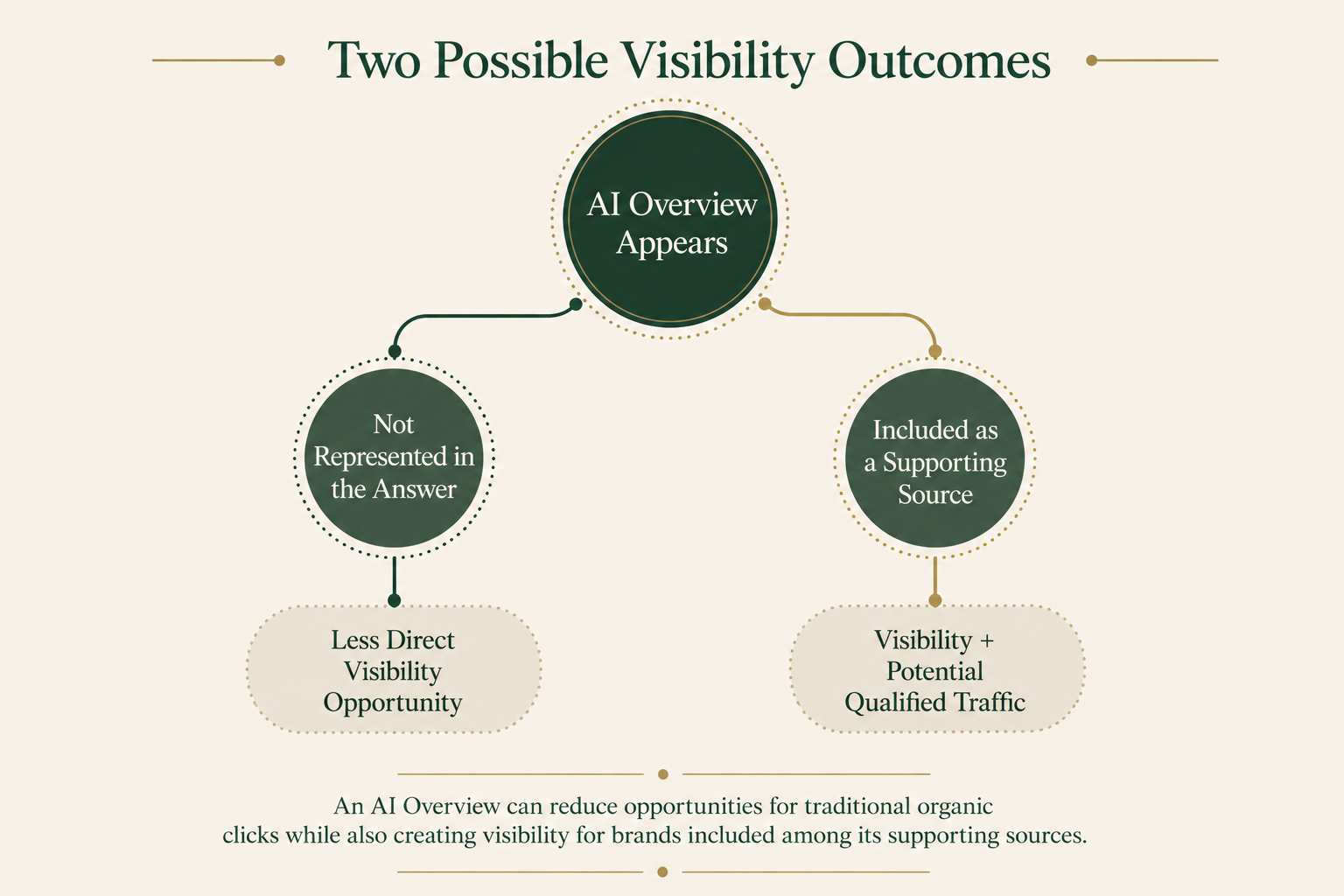
AI Overviews can reduce the number of clicks available to traditional organic results, particularly for informational queries where users can get a sufficient answer directly on the search results page. At the same time, appearing as a cited source can create a different kind of opportunity: the user sees your brand as part of the answer before deciding whether to visit your website.
The exact impact varies by query, industry, and how prominently a source is cited. Some industry studies suggest that cited sources can attract highly qualified traffic because users who click have already received context about the topic and chosen to explore the source further.
That means an AI Overview is not automatically a loss for every business. The outcome depends partly on whether your brand is absent from the answer or included as one of the sources behind it.
What this means practically: the goal isn't to avoid AI Overviews. It's to increase the likelihood that your business is represented when they appear-and to make the resulting visit valuable when a user chooses to click through.
What This Looks Like in Practice
A professional services firm. Its cornerstone “how to choose a [service]” page has held a top-three ranking for an extended period, while traffic to the page has gradually declined. The page is comprehensive, but the main answer is buried deep in a 2,400-word article. Restructuring the opening to provide a clear, self-contained answer could make the content easier for both users and search systems to understand without removing the information that already supports its organic ranking.
A regional healthcare provider. Appointment-related queries such as “what does X treatment involve” may increasingly trigger AI-generated answers before a searcher reaches an individual website. The provider's content covers the topic well, but it lacks clear authorship, visible expert credentials, and structured information that could make the page easier to evaluate and understand. Improving these elements can strengthen trust and usability while supporting the site's broader search visibility.
A B2B software company. Its comparison content ranks well, but competitors may appear more frequently across the sources users encounter during their research. One competitor is actively discussed on industry communities and review platforms, while its founder regularly contributes expert commentary elsewhere online. The company's own content may be technically strong, but its visibility is concentrated almost entirely on its own website.
The common thread: ranking well still matters, but website rankings alone may not reflect the full range of places where customers encounter, evaluate, and shortlist a business.
Best Practices: What to Actually Do
Open important pages with a clear, self-contained answer. For pages targeting specific questions, place the main answer near the beginning and make it understandable without requiring readers to work through the entire article. This can improve clarity for users and make key information easier for search systems to identify.
Use relevant structured data where it accurately reflects the page. Article, FAQ, HowTo, and other applicable schema can help search engines better understand page content, but schema alone does not guarantee inclusion or citation in an AI Overview.
Make authorship and expertise clear. Where appropriate, identify the people responsible for creating or reviewing important content and provide relevant credentials or supporting information. Keep factual content updated when the subject changes.
Build credible visibility beyond your own website. Your brand may be discovered through industry publications, review platforms, professional communities, directories, and other third-party sources. Focus on the platforms that are genuinely relevant to your industry and audience rather than trying to appear everywhere.
Track AI visibility alongside traditional search metrics. Monitor which priority queries trigger AI Overviews, whether your brand or content appears in cited sources, and how this visibility changes over time alongside rankings, traffic, and conversions.
A strong SEO and organic growth strategy should continue to form the foundation of this broader visibility approach.
Quick Checklist Callout
✔ Review important pages to ensure the main answer is easy to find
✔ Add relevant structured data where it accurately matches the content
✔ Confirm important content has clear authorship or expert review where appropriate
✔ Identify the third-party platforms and sources that matter most in your industry
✔ Add AI Overview and AI visibility checks to your regular search reporting
Common Mistakes
Treating AI Overview visibility as only a ranking problem. Traditional rankings still matter, but ranking well does not automatically mean a page will be selected or cited within an AI Overview. Businesses need to consider both organic visibility and how clearly their content answers the underlying query.
Chasing keyword density instead of clarity. Repeating keywords or adding unnecessary content does not automatically make a page more useful. Focus on clear, direct explanations that answer the user's question and provide enough context to support the answer.
Ignoring visibility beyond your own website. Customers may encounter your brand through industry publications, review platforms, professional communities, and other third-party sources before visiting your website. Building a credible presence across relevant channels can support broader brand discovery.
Waiting for a definitive AI Overview formula. Google has not published a fixed formula for source selection, and the exact process is likely to evolve. Instead of waiting for certainty, businesses can focus on the fundamentals that remain consistently valuable: useful content, technical accessibility, clear structure, credibility, and accurate information.
Warning Callout: Don't panic-rewrite content purely to try to appear in AI Overviews at the expense of readability or usefulness for actual visitors. Clear answers, credible authorship, accurate information, and regular updates are valuable beyond AI visibility. If a change makes content less useful for your audience, it is unlikely to be a sustainable optimisation strategy.
Ranking vs. Citation: What Each One Actually Tells You
Old SEO Checklist vs. AI Overview Citation Checklist
Frequently Asked Questions
Do I need to rank #1 to get cited in an AI Overview?
No. Ranking #1 does not guarantee that your page will be cited in an AI Overview. Google may select supporting sources differently from how it orders traditional organic results, so a page can rank well without appearing as a cited source.
Is there a way to guarantee my page gets cited?
No. Google has not published a fixed formula or guaranteed method for appearing as a cited source in an AI Overview. The best approach is to focus on clear, useful content, strong technical foundations, credibility, and information that directly addresses the user's query.
Do AI Overviews appear for every type of search?
No. AI Overviews do not appear for every query. Google determines when an AI-generated response is useful, and their appearance can vary depending on the query, topic, location, and other factors.
Does this replace the need for traditional SEO?
No. Traditional SEO remains important. Technical accessibility, relevant and useful content, and overall site quality continue to support visibility in Google Search. Optimising content for AI-driven search should be viewed as an additional consideration rather than a replacement for SEO fundamentals.
How do I find out if I'm already being cited?
Start by testing important customer queries that may trigger an AI Overview and checking whether your website appears among the cited sources. You can also monitor available referral data and use AI visibility or citation-tracking tools where appropriate for more structured monitoring.
Key Takeaways
AI Overviews are changing how search visibility works. They can provide answers directly within Google Search, reducing the opportunity for some traditional organic listings to receive a click.
Ranking and citation are related but different outcomes. A strong organic ranking does not guarantee that a page will be selected as a cited source in an AI Overview.
Clear, useful content matters. Content that directly answers a user's question, is easy to understand, and demonstrates relevant expertise can make information easier for both users and search systems to evaluate.
AI Overview visibility creates both challenges and opportunities. Businesses may lose some traditional organic clicks when AI-generated answers satisfy a query, but being included as a cited source can give a brand visibility within that answer.
AI visibility does not replace traditional SEO. Technical accessibility, relevant content, site quality, and credibility remain important foundations. Businesses should build on these fundamentals while also monitoring how their content appears across AI-driven search experiences.
Get a Free AI Overview Visibility Check and understand how your priority queries are appearing in AI-driven search, where your brand may be missing visibility, and what you can realistically improve first.